Corpus

Start Your Business.Know the Rules.

Corpus forms your company in all 50 states + DC — then shows you the state and local rules that actually apply to it, in plain English, with a citation to the law behind every answer.

State filing fee + Corpus service fee. Choose your state to see the current state filing fee and Corpus service fee before purchase.

The part nobody warns you about

Forming the company is the easy part.

The certificate arrives and the real work starts. Every level of government has a rule for your new business — and they don't show up as a checklist. They show up as a letter, a fine, or a shutdown.

  • Sales-tax permit
  • Home-occupation limits
  • Zoning use controls
  • Health permit
  • Signage rules
  • Annual report
  • Registered agent
  • Local privilege license

And the worst part is not knowing what you don't know.

The rule that depends on where you stand

Your address decides half your rulebook.

Zoning is about where you do it, not just what you sell — and it's the layer founders find out about last. Every district below is a real zoning district from that city's official GIS layer — and every one links straight into that city's own zoning code. Click any district to see the code behind it.

That's the same library Corpus searches when it tells you what applies to your business: form your company through Corpus and the compliance pass reads federal, state, and municipal law for your state, wherever we've published it — including zoning code like this.

We don't map your specific parcel from your street address yet. Today you get the district and the code that defines it.

See it for yourself

Pick a business. See what actually applies.

These are real provisions from the Corpus library — not a mockup, not a summary of one. Open any citation to read the full official text.

Starting a home bakery in Philadelphia, Mississippi

3 provisions found

In plain English

Most people miss this

You can stay unpermitted — but only under $20,000 a year, and you cannot sell online.

Mississippi lets a cottage food operation skip the health-department permit, but the exemption has hard edges: gross sales across all locations must stay at or below $20,000 a year, and sales over the internet, by mail order, at wholesale, or to a retail establishment are each outside it. Every package carries a label with the operation's name and address, the ingredients by weight, allergen information, and a specific disclosure line in at least 10-point type.

The law itself

A cottage food operation must comply with the applicable requirements of this section but is exempt from the permitting requirements of Section 41-3-18 if the cottage food operation complies with this section and has annual gross sales of cottage food products that do not exceed Twenty Thousand Dollars ($20,000.00)… A cottage food operation may not sell or offer for sale cottage food products over the Internet, by mail order, or at wholesale or to a retail establishment… A cottage food operation may only sell cottage food products which are prepackaged with a label affixed that contains the following information: The name and address of the cottage food operation… The ingredients of the cottage food product, in descending order of predominance by weight… Allergen information as specified by federal labeling requirements… The following statement printed in at least ten-point type in a color that provides a clear contrast to the background of the label: “Made in a cottage food operation that is not subject to Mississippi’s food safety regulations.”
Miss. Code Ann. § 75-29-951Regulation of cottage food operations

In plain English

Before you sell anything

The sales-tax permit has to exist before the business starts — not after.

Mississippi requires a sales tax permit before a taxpayer engages in business in the state. Selling first and registering later carries a specific consequence: the retail rate becomes due on everything purchased in-state during that period — including inventory bought for resale — along with back returns for each period, plus penalties and interest. The section is not purely punitive, though: on that return the taxpayer may credit sales tax already paid on purchases that would have counted as wholesale sales, where documentation substantiates them.

The law itself

A taxpayer is required to obtain a sales tax permit under Section 27-65-27 before engaging in business in this state. If a taxpayer fails to obtain a sales tax permit before engaging in business in this state, the taxpayer shall pay the retail rate on all purchases of tangible personal property and/or services in this state, even if purchased for resale. Upon obtaining a sales tax permit, a previously unregistered taxpayer shall file sales tax returns for all tax periods during which he engaged in business in this state without a sales tax permit, and report and pay the sales tax accruing from his operation during this period and any applicable penalties and interest. On such return, the taxpayer may take a credit for any sales taxes paid during the period he operated without a sales tax permit on a purchase that would have constituted a wholesale sale if the taxpayer had a sales tax permit at the time of the purchase and if proper documentation exists to substantiate a wholesale sale.
Miss. Code Ann. § 27-65-3Definitions — sales tax permit

In plain English

If you outgrow the exemption

Selling packaged goods for off-site consumption makes it a retail food establishment.

Past the cottage-food exemption, a licence from the commissioner is required for each location before the business opens. The fee is $10, the licence expires every June 30 rather than rolling over, and it is not transferable — a change of location or ownership means a new application.

The law itself

“Retail food establishment” means any establishment where food and food products are offered for sale to the ultimate consumer and intended for off-premise consumption… Each retail food establishment, before engaging in business, shall obtain a license from the commissioner. Owners of more than one (1) retail food establishment must obtain a license for each establishment. A license fee of Ten Dollars ($10.00) must be paid to the department before a license will be issued… Licenses issued under this subsection by the commissioner shall expire on June 30 each year and application for renewals thereof shall be made annually before the expiration date. Licenses shall not be transferable and application must be made for a new license if there is any change in location or ownership of the business.
Miss. Code Ann. § 69-1-18Retail food establishment licensing

Drawn from law already published in the Corpus library and cached on 2026-07-24 — not regenerated per visit. Open any citation to check it against the official text.

Search the full library free →

The path

From idea to operating.

Three steps. The first one costs money; the other two are why you'd pick Corpus over a filing service.

Step 1

Form your company

Pick your state. You see the state filing fee and the Corpus service fee itemised before you pay. A human approves the filing before anything is submitted to the state.

Step 2

Find your rules

Corpus searches federal, state, and municipal law for what applies to your kind of business in the place you actually operate — and cites the provision behind every answer.

Step 3

Know what comes next

Registrations, permits, renewals, deadlines. The obligations that arrive after the certificate — the ones a filing service hands you a PDF about and wishes you luck.

What it costs

One checkout. A human on every filing.

The state's fee is the state's fee — we show you exactly what it is and exactly what we charge on top.

  • One checkoutA single payment covers the state filing fee, registered agent for year one, and the Corpus fee. After that the only recurring Corpus charge is registered-agent renewal, a flat $99/yr — stated here on day one, not sprung on you later. Your state may separately charge its own annual-report fee.
  • Human-gated filingOur AI agent prepares your filing, then stops. You pay first, then a person reviews the exact payload — cryptographically hash-locked, so what gets filed is what was approved — before anything is submitted to the state. Full refund any time before that submission.
  • Certificate deliveryOnce the state accepts your filing, Corpus retrieves your Certificate of Formation and delivers it with an append-only record of every step taken.

State filing fee + Corpus service fee. Choose your state to see the current state filing fee and Corpus service fee before purchase. Registered-agent service for year 1 is included in your total. EIN filing is optional and priced separately, when available. See the 5-year comparison →

Why we can answer that

We built the library first.

A filing service can file your paperwork. It can't tell you that Texas treats a software subscription as a taxable data processing service, because it doesn't have the Texas Tax Code. We do.

551,201Live provisions published
18Jurisdictions · 16 searchable
879,302Searchable passages
8Cities with zoning maps

The legal corpus is live: this count comes from the same coverage source shown on Verify Corpus. Municipal coverage is expanding through agentic acquisition, so depth varies by jurisdiction.

Where it started

Philadelphia, Mississippi never digitized the code it enforces.

The city enforced a municipal code its own residents couldn't read. After a 240-day public-records fight, we photographed the book and published it ourselves — free, permanently. That became Corpus. It's also why the library is free and the formation service is what you pay for.

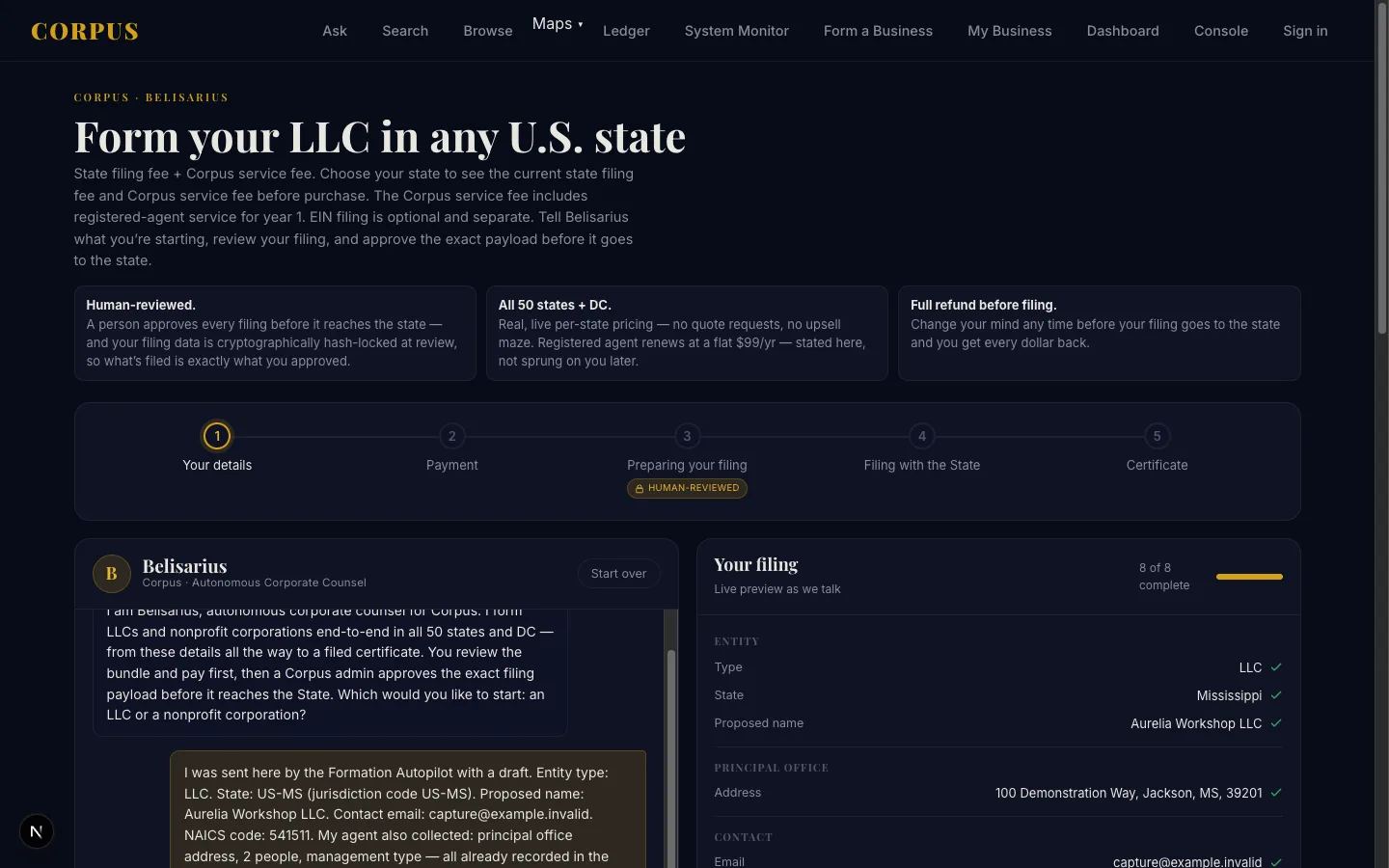
Corpus formation intake, showing state selection
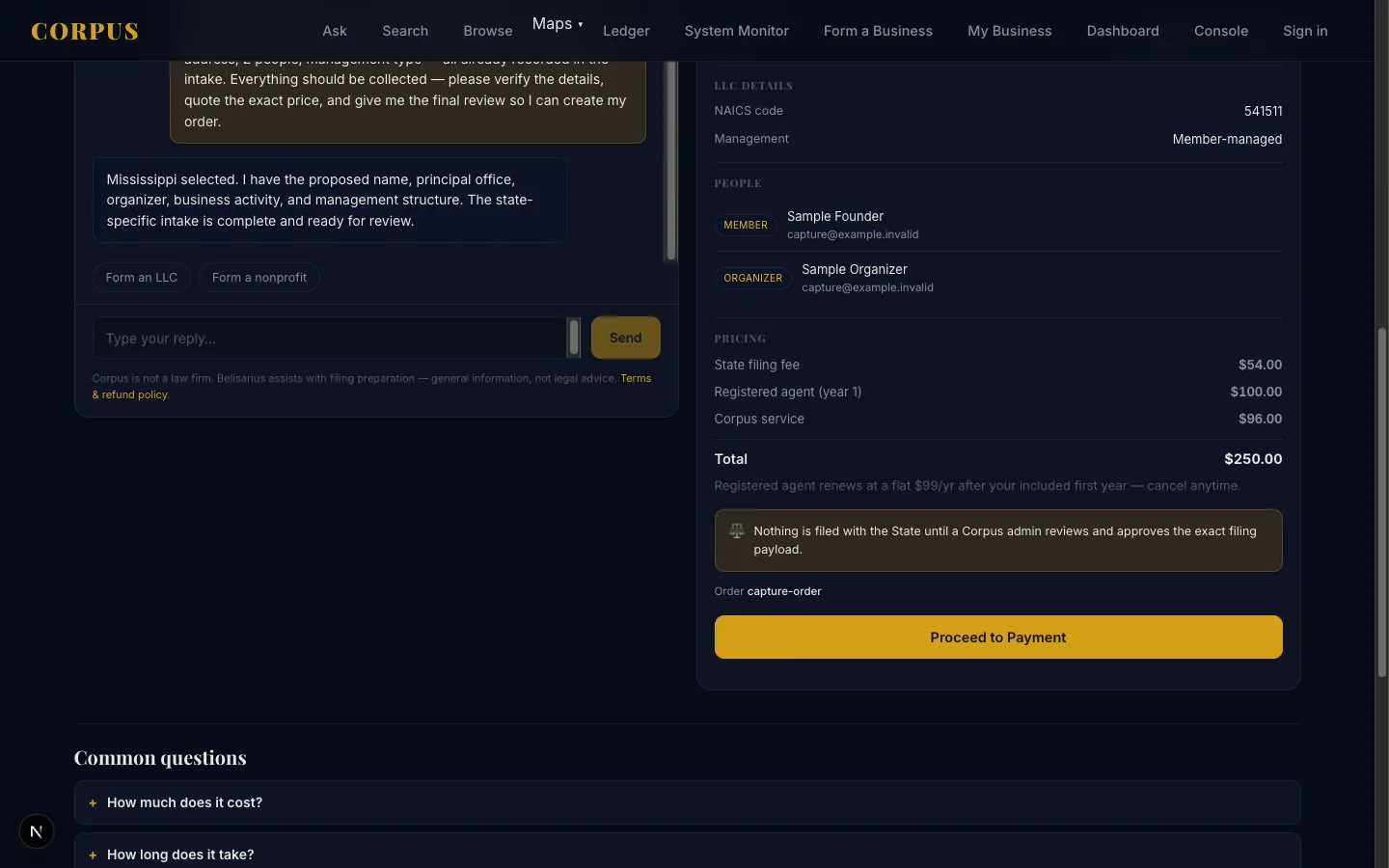
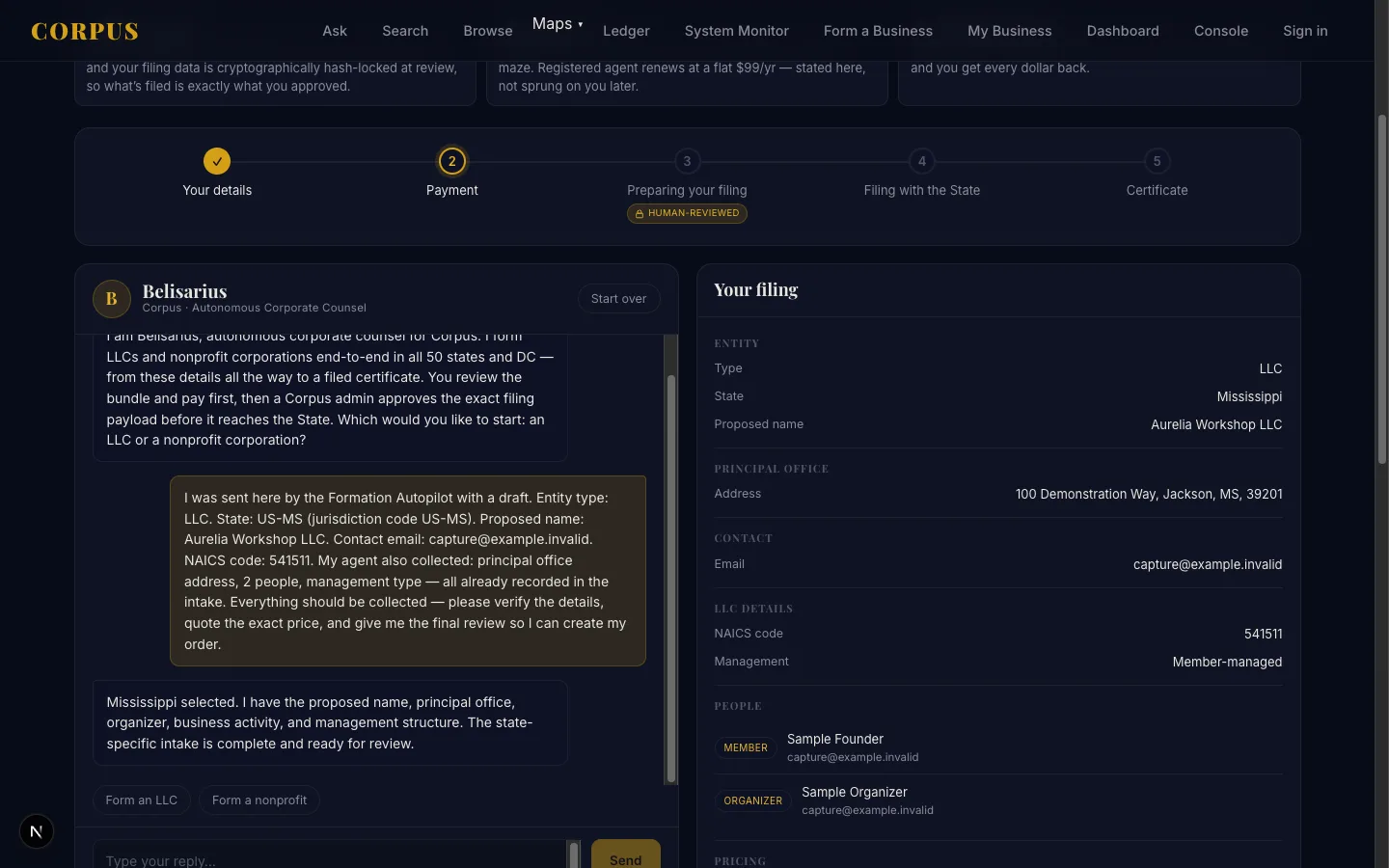
Real product · fictitious company data
State-specific pricing shown before purchase
State pricing, shown before checkout
The human approval gate before a filing is submitted
The human approval gate

The engine behind the product

What your filing funds.

Corpus is the body of law. The agent doesn't just use the Corpus. It helps build it. One face is a public law library anyone can read for free. The other is the formation service founders pay for. Every dollar the second earns goes into growing the first — that's the whole business model. Formation is available in all 50 states + DC. No ads, no selling your data.

The free library

Federal, state, and municipal law — searchable, browsable, and answerable with citations. No account required. Free stays free.

Search the law →

The transparency scoreboard

State law requires municipalities to publish their codes. Some don't. We track every records request, every missed deadline, every day overdue — on a public board.

See the scoreboard →

Codes bought back

When a city answers a records request with a fee estimate, we open a public campaign for it. Once funded, the code is digitized and published free, permanently.

See active campaigns →

Why the name

In 529 AD, Roman law was a thousand-year sediment of overlapping edicts nobody could search. Justinian had it compiled into one authoritative body — the Corpus Juris Civilis. Three centuries later the Basilika translated it out of elite Latin into the language people actually spoke. That's the whole product in two sentences: compile it, then translate it. Justinian is the intelligence and organization layer; Belisarius is the action layer, handling municipal code acquisition and customer formation under human authorization.

A formed company, and a clearer view of what comes next.

Start in any of the 50 states or DC. See every fee before you pay one. A human approves the filing before it's submitted.

Corpus is not a law firm and does not provide legal advice. Legal-depth coverage varies by jurisdiction — see what's published before you rely on it.